PROFILE | Deborah Halpern: Whimsical Joy
The artworks of Deborah Halpern OAM are wonderous enmeshments of joy and intricate technicality. Her practice embraces various speeds, from quick and gestured paintings to measured and meticulously labored sculptures. Regardless of the selected medium, the works are imbued with a sense of blissful whimsy.

Deborah Halpern’s studio is engulfed with works in progress occasionally dispersed with other images and sculptures that illicit happiness. In the vast double window space, Halpern is surrounded by her creatures in various states of becoming. Sculptures in their nascent fibreglass stages are lined up on the shelves, others hang from the ceiling on self-crafted pully systems, anticipating their turn. Large format paintings cling to the walls, decorated with the unforgiving medium of spray paints. And a cabinet of maquettes for the larger sculptures congregate in a vitrine like a cabinet of curiosities.
The pursuit of an artistic life was inevitable for Halpern. She grew up (and still lives) in the small, bushy “really far out” suburb of Warrandyte. In the 1960s, the suburb northeast of Melbourne was a “mish mash of creative people,” home to writers, animators, painters and potters. The mish mash included her parents, her mother, Sylvia, a potter, and her father, Artur, an entrepreneurial engineer who created mass produced pottery. Warrandyte was formative to Halpern’s thinking, and it wasn’t until later at school that she discovered that not everybody lived according to their creative pursuits. She describes herself as being a “quiet, introspective child” and a writer. What she did know was that she wanted to write and work with animals – eventuating in the creation of creatures and devising of titles.
Halpern “sort of” trained as a potter. Following high school she attended the Warrandyte Potter’s School—part of the famed Potters Cottage cooperative which operated from 1958 to 2004—where she learnt how to throw and use the kick wheel. The education suited Halpern well as it fostered an experimental space and encouraged the development of distinct styles. Despite their artistic practices, Halpern was adamant not to learn pottery from her parents, admitting that “the process would’ve been a nightmare.” Determined to forge her own artistic path, she wanted to create “pottery [that was] nothing like my parents” and therefore began creating “in a domain of rejection.”
This push away from her parents and local makers in Warrandyte pulled her towards European influences including Antoni Gaudí, Pablo Picasso, and Niki de Saint Phalle. These seminal influences are acutely present in Halpern’s practice in their bold colours and abstracted forms. Gaudí’s tiles and glass panes scaling buildings, forming a swirling mosaic of otherworldly construction are complemented by de Saint Phalle and Picasso’s abstracted and simplified forms.
These influences coalesced into “crazy little sculptural things” that were exhibited early in her career in a two person show at Potters Cottage with her mother in 1978. The successful show marks a tipping point in Halpern’s practice, where “the works became more and more sculptural.” Following the enthusiastic reception of the Potters Cottage exhibition, Halpern experienced another success at the Christine Abrahams Gallery in Richmond [Victoria]. The exhibition profiled paintings, with some sculptures three or four meters in height cheekily “thrown in.” The National Gallery of Victoria (NGV) acquired one sculpture, and the National Gallery of Australia, another. These colourful, whimsical and playful works were clearly “what people are responding to,” which affirmed Halpern’s already burgeoning style.

Installation view, Angel, 1988, ceramic, steel, concrete, 924.5 x 992.5 x 351.5 cm, National Gallery of Victoria, Melbourne.
Following this reception, and whilst travelling in Europe on an Australia Council grant studying Outsider Artists, Halpern was commissioned by the NGV for a work to be exhibited in the moat in front of the “imposing grey wall” of the gallery on St Kilda Road. Angel, 1988, possibly Halpern’s most well known large-scale public works, radically pushed her practice. The sculpture was constructed using handmade ceramic tiles that were glazed, fired, and cut “so that it would lie down and look like cloth.” The painted panels cloak the steel animalistic like structure revealing paintings of animals and people, both real and imagined. Angel instigated Halpern’s continued approach to her works, that is “joyful, that is provocative and is inviting.” She wants “people to be bewildered and engaged.”
Following this major commission, it made sense to Halpern to use the offcuts from Angel to make similar works on a reduced scale, a practice now central to her work today. When discussing her recent works, Halpern provocatively states that she “is not really into mosaic,” rather, the sculptures are more aligned with the practice of dressmaking. The precise piecing together of tiles sheath the structures like drapes of impenetrable fabric.

Deborah Halpern, Dove, 2024, glass, steel and fibreglass, 180 x 155 x 82 cm
The conception of the sculptures is not initiated by flat drawings, instead, this is a concurrent gestural practice at odds with the meticulous tiling. The works on paper are a stream of consciousness often depicting feminine faces alongside furry companions in bold, confident strokes. The sculptures often originate as maquettes, a process that assists in the decision-making process of “is it going to have two legs, is it going to have three legs, is it going to be on a spike, what’s it going to do, is it going to hang from a tree?” The three-dimensional model permits the testing of ideas physically, the ability to see it from various angles and determine its friendly or encompassing scale.
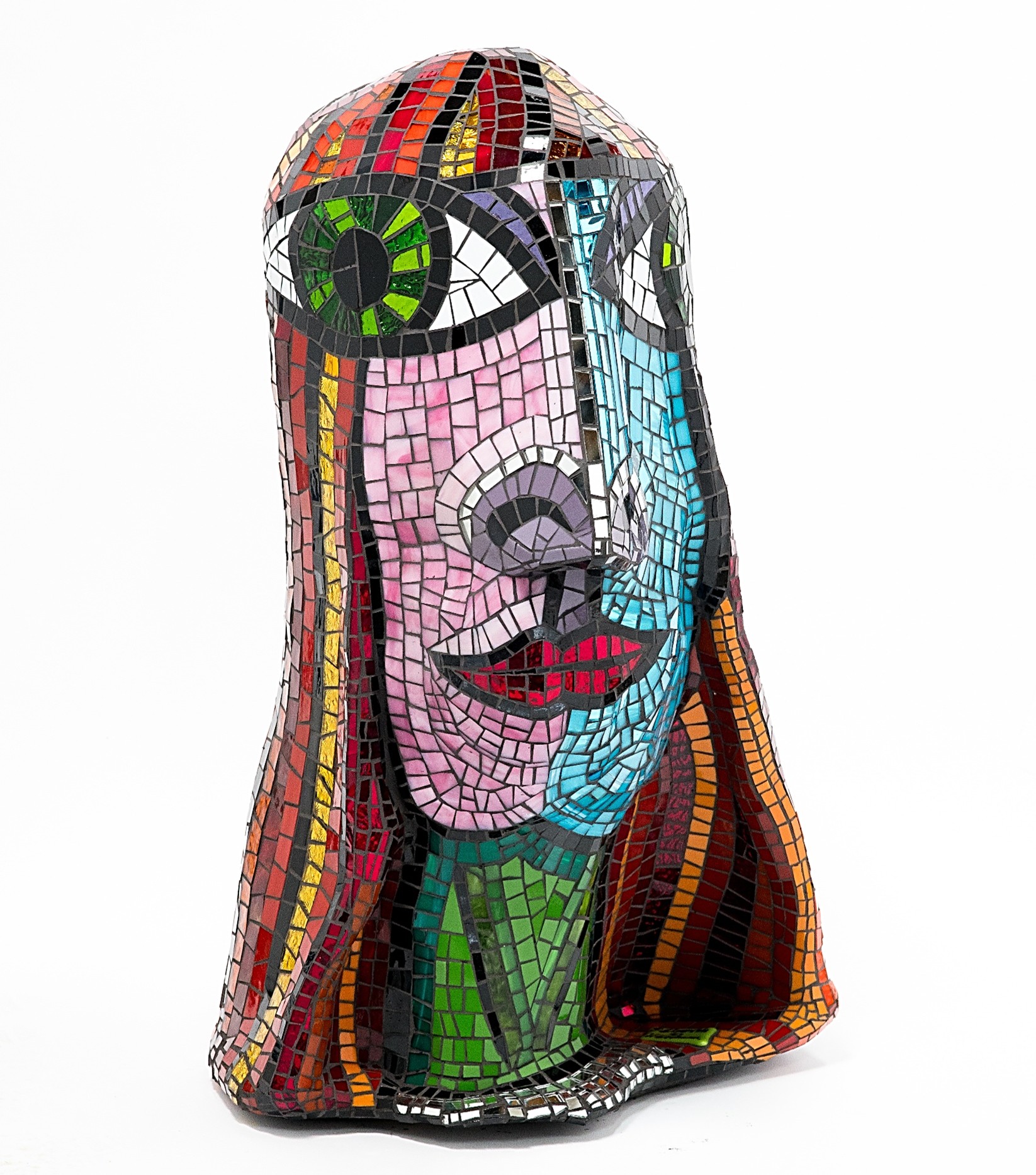
Deborah Halpern, Ruby, 2024, glass, steel and fibreglass, 84 x 54 x 50 cm.
During her practice, the materiality of the tiles shifted from handmade to commercial, and more recently to glass. Not only is glass more resilient to varying weather conditions, in which her sculptures often find themselves, but the light interacts with the material in a different way, bouncing off rather than skimming along the ceramic tile. Unlike the sculpture’s forms, the colours they embolden are not mapped prior to their construction. For Halpern, selecting the glass tiles is akin to being “a kid in a toy shop,” and their selection is based on the “ones [she] responds to.” Halpern adorns the fibreglass models one section at a time, and “generally puts the eyes in first so they can see.” The colours are placed based on intuition and graded to suggest shadows cast from dimensionality. For her upcoming sculptural exhibition at Arthouse Gallery, Sydney, Halpern favours mirrored glass tiles. Aeroplane Jelly, 2025, a scaly creature adorned with alternating shimmering tiles in checkered patterns of greens, reds, pinks and blues soars. While in her sculpture Blue Cat Flower, 2025, the abstracted feline face is held in the belly of the blue flower and mischievously peers outwards towards the viewer.
Halpern’s creatures, both gesturally or meticulously formed into existence, permeate a sense of joy and bewilderment. Her abstract-influenced forms elicit intrigue and whimsy, an encounter often not experienced in the current state of the world, but one so desperately needed.
Exhibitions
Creatures of Love
12 February – 8 March 2026
Arthouse Gallery, Sydney
Beechworth Biennale
7-9 March 2026
Beechworth, Victoria
Maquette Sculpture Award
22 November 2025 – 22 March 2026
McClelland Sculpture Park and Gallery, Victoria
Images courtesy of the artist; Niagara Galleries, Melbourne; Arthouse Gallery, Sydney, National Gallery of Victoria, Melbourne and Mia Mala McDonald.
Nikita Holcombe is an independent writer, curator and researcher living and working on Wurundjeri land, Victoria.
This article was first published in Artist Profile Issue 73.
Women Photographers 1900–1975: A Legacy of Light draws on more than 300 photographs and photomedia from the National Gallery of Victoria’s (NGV) collection and the...

Motet Fail, 2026, reshapes Artist Run Initiative, West Space into an immersive backgammon board that operates as a site of reflection, encounter, and quiet concert....

Carvings have been made for all time by Aurukun men. However, the more recent innovation to emerge from Aurukun are paintings. Vested in Country and...

A stone’s throw from the Illawarra escarpment at Campbelltown Arts Centre, the introduction to Draper’s ecosphere is a gathering of rainbow forms which, as an...

In 1991, Maurice and Katia Krafft died during the Mount Unzen eruption on Japan’s island of Kyushu. Herzog’s documentary does meditate on their deaths and...

Ruby Arrowsmith–Todd started attending the AGNSW film program in its early days as a self-educated, die-hard film fan, immersing herself in the cinematic sea of...
For most painters, tape has a prophylactic function. Stuck temporarily onto a canvas (or a doorframe, for that matter), tape protects what lies beneath or...
I recently left my home-studio on the Vaucluse clifftops in Sydney, with the whale and ocean views, and have set up a new studio in...
On a research trip to see the disused Mayday Hills Asylum, where Mike Parr will create his video projection on the exterior of the Birches...