Adriana Māhanga Lear
Adriana Māhanga Lear is a Wollongong-born and based artist of Tongan descent, with ancestral ties to Tu'anuku, Vava'u and Vaipoa, Niuatoputapu. She works across photography, video, sculpture, installation, and sound. She’s also a musician, composer / producer, and researcher.


In the final weeks of her PhD thesis deadline, Adriana is generous with her time and her words. She speaks fluently about her interdisciplinary practice, which is motivated by aims of decolonisation, Indigenous self-determination, and social justice across Moana Oceania (the Pacific). Interested in the intersection of sound and visuals as equal conduits of meaning and experience, Adriana uses her body at the centre of this exchange.
You take an embodied, decolonial approach to issues of gender, sexuality, and identity. In your own life, where does this focus stem from?
As a Tongan-Australian queer / leitī woman, issues of intersectional feminism and queer Moana Oceanian representation are deeply important to my work. This stems from my own experiences of erasure and prejudice underpinned by larger issues of coloniality. In many of my works, I use my body to “speak back” to the archive.
Sound seems to be the pulse of your practice—sonic experiments, live music performances, music scores, soundscapes, recorded music . . . I’m interested in the origins of music in your life.
As the first of my mother’s family to be born in Australia, I was fortunate to grow up with relatives from both sides of my family. From my grandmother I was introduced to Tongan music, weaving, and language, while also being immersed in my father’s record collection of rock and heavy metal greats like Led Zeppelin, Jethro Tull, The Doors, Hendrix, and Neil Young.
I began learning the European concert flute at the age of four. A disciplined student, dedicating hours each day to practice, I excelled quickly. By thirteen I’d performed nationally and internationally. However, although I felt immense pride from my Tongan family for my musical achievements, I also felt a sense of disconnection—that European music made me an outsider in my community. In 2003, my practice was overcome with what I now know to be OCD [obsessive-compulsive disorder], which prevented me from performing to the same standard. I didn’t perform the flute again until 2011.
Since then, the flute has become an important tool and trope in your art. In works such as Fākafoa – The Body Breaks in Waves, 2024, you play the fangufangu (bamboo nose-flute). . .
Yes, contributing to the revitalisation of the fangufangu and its deeper history is central to my practice. Fākafoa – The Body Breaks in Waves features six fangufangu parts, three of which replicate the pitches of 1800s fangufangu in museum collections. The work also revitalises and reimagines ancient Tongan mourning practices into body percussion forms. I perform all nine instrument parts as visual motifs in a multi-channel audio-visual work, which is accompanied by a printed score I created.
You also played the fangufangu, repeatedly, in Tu’uloa – In standing, to endure, 2024. How do you prepare for a live endurance performance like this?
For this work I “re-sound” eighteenth century European transcriptions of Tongan durational music performances by women, with Tongan aesthetic concepts and practices that are “missing” in the European notations. In my performance, I repeat a melodic motif through repeated physical movement on the fangufangu. Being a wind instrument player, swimming, and more recently running, help me with breathwork, while mindfulness meditation is helpful for the psychological aspect of endurance performance.
How does this concept of “re-sounding” inform your practice, conceptually?
In Moana Oceanian thinking, we walk forward into the past and backwards into the future. This inspires my approach to “re-sounding” and “re-staging” written, visual, sonic, and material archives, and building on ancestral practices in new ways and in new contexts. One way I challenge the Eurocentric and heteropatriarchal legacies of coloniality is through sonic mechanisms that encourage “decolonial listening,” to question our systemic listening privileges, biases, and habits.
Additionally, my practice is grounded in the holistic treatment of sound and music as faiva (“performance”) arts that exist in relationship with tufunga (“material”) and nimamea’a (“fine”) arts. My practices extend kupesi found in tufunga and nimamea’a arts, from a visual to sonic concept and practice of motif, symbolism, and identity. For example, in ‘Otua hala he sikotā – Messages from the Dead, 2024, I use kupesi as a visual language for representing sound, through graphic notation of fangufangu melodies, which I created from Tongan bird songs.
‘Otua hala he sikotā – Messages from the Dead was part of your most recent series, Fafangu: to awaken, 2024, commissioned by the Casula Powerhouse Arts Centre. What did the research process for this work involve?
Fafangu: to awaken reimagines ancient Tongan women’s mourning practices connecting to Hikule’o, as sites of performance focused on the body, sound, and place as mediums of relationality. It was developed over four years and involved learning the fangufangu, global tālanoa (talking critically yet harmoniously) with specialists in Tongan music, arts, and culture, analysis of sound archives and research of collections at the Tonga National Museum, Australian Museum, Te Papa Tongarewa Museum of New Zealand, and Übersee-Museum Bremen in Germany.
This series (re)awakens the sound of the fangufangu, which is known as ongo fa’ahikehe (sound of the dead or ancestral sound) and its creator Hikule’o, the female and gender-fluid, highest-ranking ‘otua (deity or God/dess) of ancient Tonga. During the nineteenth century Christian missionisation of Tonga, ongo fa’ahikehe was renamed ongo tēvolo (sound of the devil) and Hikule’o was deemed “evil.”
Favourite work(s)?
Fale ‘o Hikule’o – House of Echoes, 2024, springs to mind for the opportunity it gave me to work in a [large] scale I had not attempted previously, and with both my mother and Aunties in Tonga to produce fala (woven pandanus mats), tapa (beaten barkcloth), and kafa (ropes) made of mine and my mother’s hair, cut during a time of grief. This work is an oversized sculptural representation of Tongan mourning concepts and practices including fakatauanga’a (dressing of a person or building in old mats) and ta’ovala pātetele (old, torn, oversized mats).
You’re a self-taught visual artist, engaging in both digital art forms and ancestral practices such as barkcloth-marking (ngatu). Are there formative moments that cemented your path as an exhibiting artist?
In 2015, I created Bleeding Earth, an audio-visual work that reflected on the impact of climate change on the Moana Oceanian region from a diasporic perspective. On the basis of this work I was invited to take part in my first artist residency Studios Switch, curated by Adam Porter at Casula Powerhouse Arts Centre. This moved my practice from the stage to the gallery space, which is where I continue to work.
Exhibitions
Fafangu: to awaken
5 July – 7 September 2025
Wollongong Art Gallery, NSW
Fafangu: to awaken
22 February – 29 March 2025
Māngere Arts Centre – Ngā Tohu o Uenuku, Aotearoa, NZ
Cunning Revived
29 November 2024 – 9 February 2025
Blue Mountains Cultural Centre, NSW
This profile was published in Artist Profile, Issue 69, 2024.
Images courtesy of the artist, and Casula Powerhouse Arts Centre, NSW
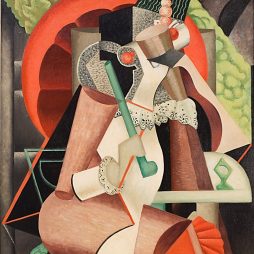
Australian art history still holds many gaps. The life and work of John Joseph Wardell Power (1881–1943) is one of them. Curated by Ann Stephen,...
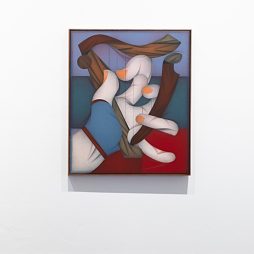
Mitch Cairns: Restless Legs was commissioned for the Contemporary Projects series at the Art Gallery of New South Wales in Sydney, where it was first...
Pulse, the title of his current exhibition at Utopia Art Sydney, alludes to the rhythmic equilibrium of parts that has long characterised his work. As...
Visiting Venice in late June, once the champagne flutes have emptied and the holders of “professional” badges have flown home, offers a different kind of...
The curator Con Gerakaris’s considered arrangement of diverse works conjures the distinctive cultural and physical topographies of Asia. Entering A Tear in the Fabric, the...
Walking into Anna Johnson’s studio is like passing through a portal into another world: a flight of rickety wooden stairs leads to the top floor...
After winning the Fishers Ghost Open Art Award last year for her epic video installation Margaret and the Grey Mare, 2023, opportunities across the theatre,...
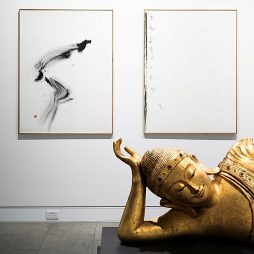
Co-curators and longtime friends Helen Hyatt-Johnston, Brad Buckley, and Noel Thurgate and Gallery Curator Lizzy Galloway, selected the Buddha from Harpur’s extensive collection of Ch’an...
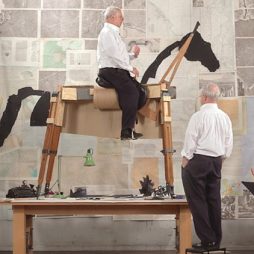
William Kentridge’s Self-Portrait as a Coffee-Pot opens with the artist pacing back and forth against the backdrop of his studio, with remnants of a sketch...