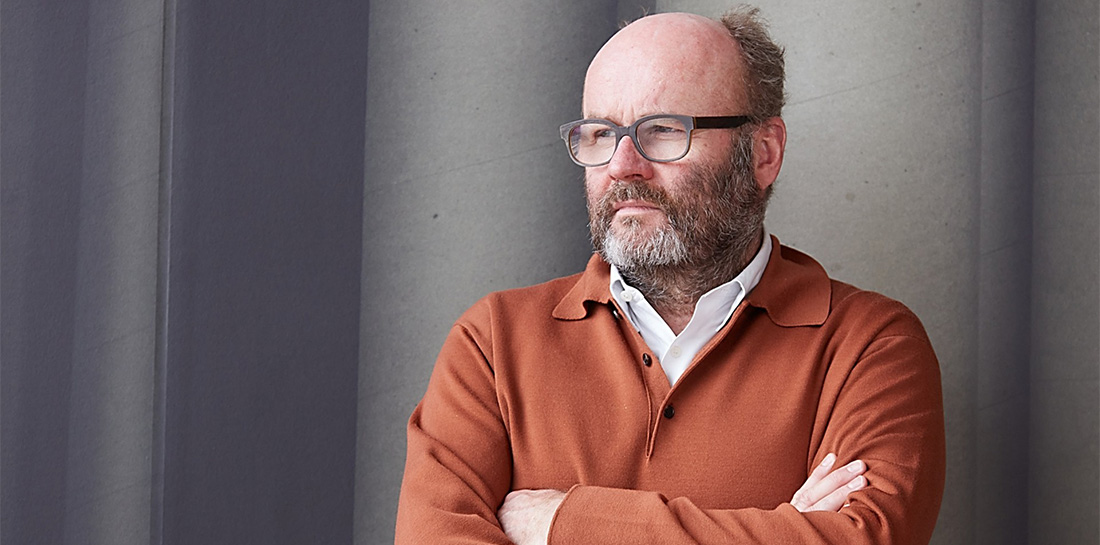
REVIEW: Thomas Demand: The Object Lesson
Curated and designed by the German artist Thomas Demand, "Kaldor Public Art Project 38: Thomas Demand: The Object Lesson" features examples of work selected from the John Kaldor Family Collection gifted to the Art Gallery of New South Wales. It represents the second time Demand has collaborated with the renowned art impresario and philanthropist, John Kaldor. The first was in 2012, Kaldor Public Art Project 25: The Dailies, at the Commercial Travellers’ Association in Sydney. On the fourth floor of the hotel, Demand installed photographs of large paper models of everyday scenes he had created, photographed, and then destroyed. From constructing models to often designing the interiors of his own exhibitions, the artist has now taken up Kaldor’s invitation to create a special space for some of this exceptional collection.
Kaldor Public Art Project 38 is in the Naala Badu building (the term for “seeing waters” in the Gadigal language). Demand, as it happens, has an indirect affiliation with Naala Badu. Over the years, he conducted research visits to Tokyo at SANAA, the distinguished architectural firm led by Kazuyo Sejima and Ryue Nishizawa, responsible for the design of Naala Badu.
Kaldor Public Art Project 38 at first registers as a rather haphazard configuration of suspended coloured screens on which the art is displayed. This belies the fact that its blueprint is in fact a small work on paper by Sol LeWitt, a key figure in conceptual art and minimalism. Perplexingly titled, The location of twenty-one lines from midpoints mostly, 1974, the drawing constitutes a broadsheet accompanying the exhibition. It also appears together with two other white geometric sculptures by LeWitt at the entrance to the exhibition. Incidentally, none of the works have customary labels with size and medium. Viewers must make of that what they will.
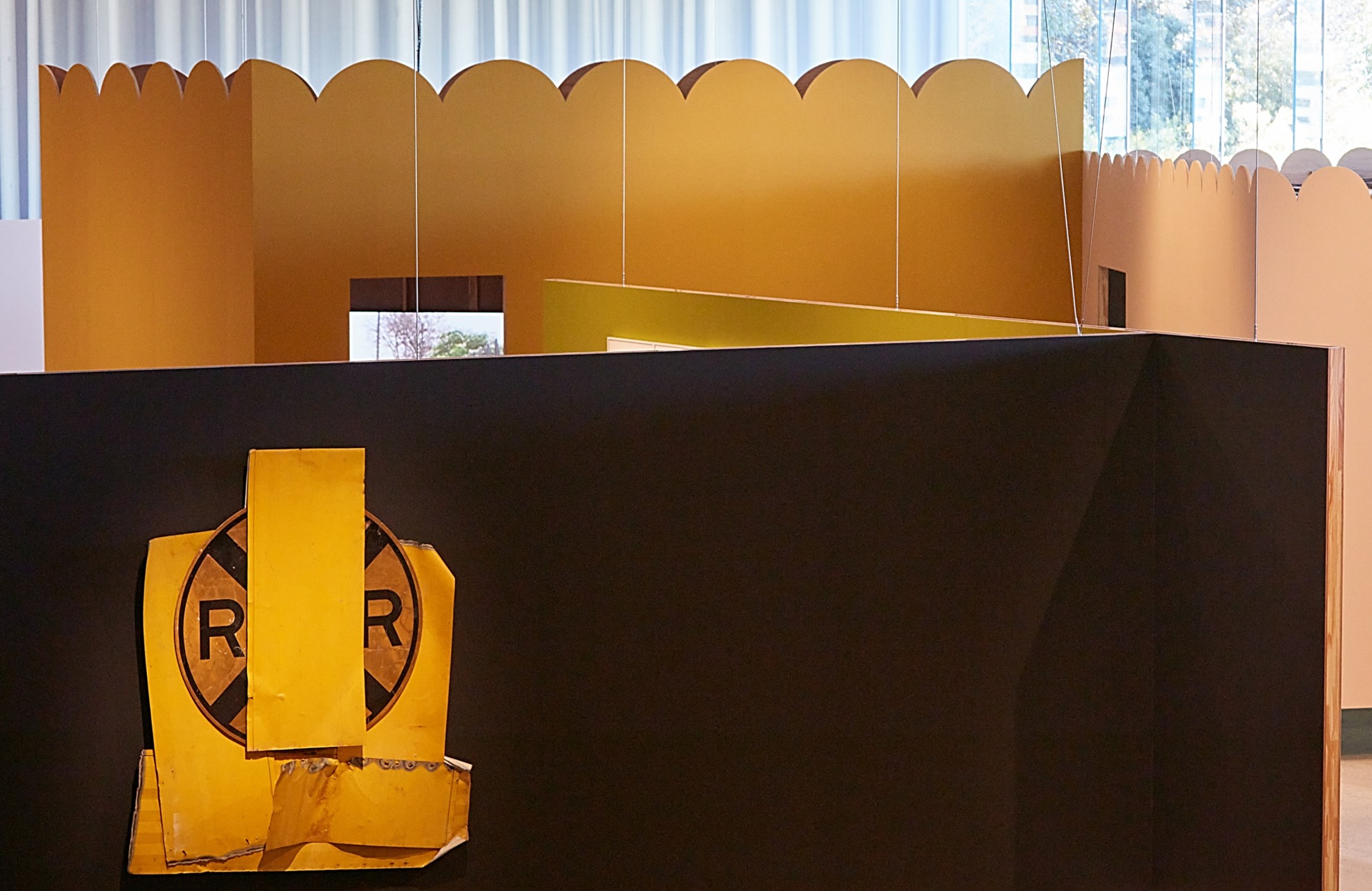
Installation view details, Thomas Demand, Kaldor Public Art Project 38: Thomas Demand: The Object. Art Gallery of New South Wales, Naala Badu, 2025. In view, Robert Rauschenberg, Yellow visor glut, 1989. Photo Art Gallery of New South Wales, Jenni Carter.
Once plugged into Demand’s strategies, we can then indulge in the remarkable range of art on display. The first room is stunning, bringing together luminaries such as Robert Rauschenberg, Christo, and the intriguing South Korean, Naim June Paik, whose coloured pencil on paper panels gently beguile. Rauschenberg’s Yellow visor glut,1989, in sharp contrast, is made of car parts and road signs, abrasive in its immediacy that conceals as much as it reveals. Christo, meanwhile, is represented by the enticingly enigmatic Wrapped Paintings, 1968. That same year, ’68, together with his wife and life-long partner, Jeanne-Claude, Christo installed their 5,600 Cubic Meter Package at Documenta IV, Kassel, a photograph of which appears in Kaldor Project 38.
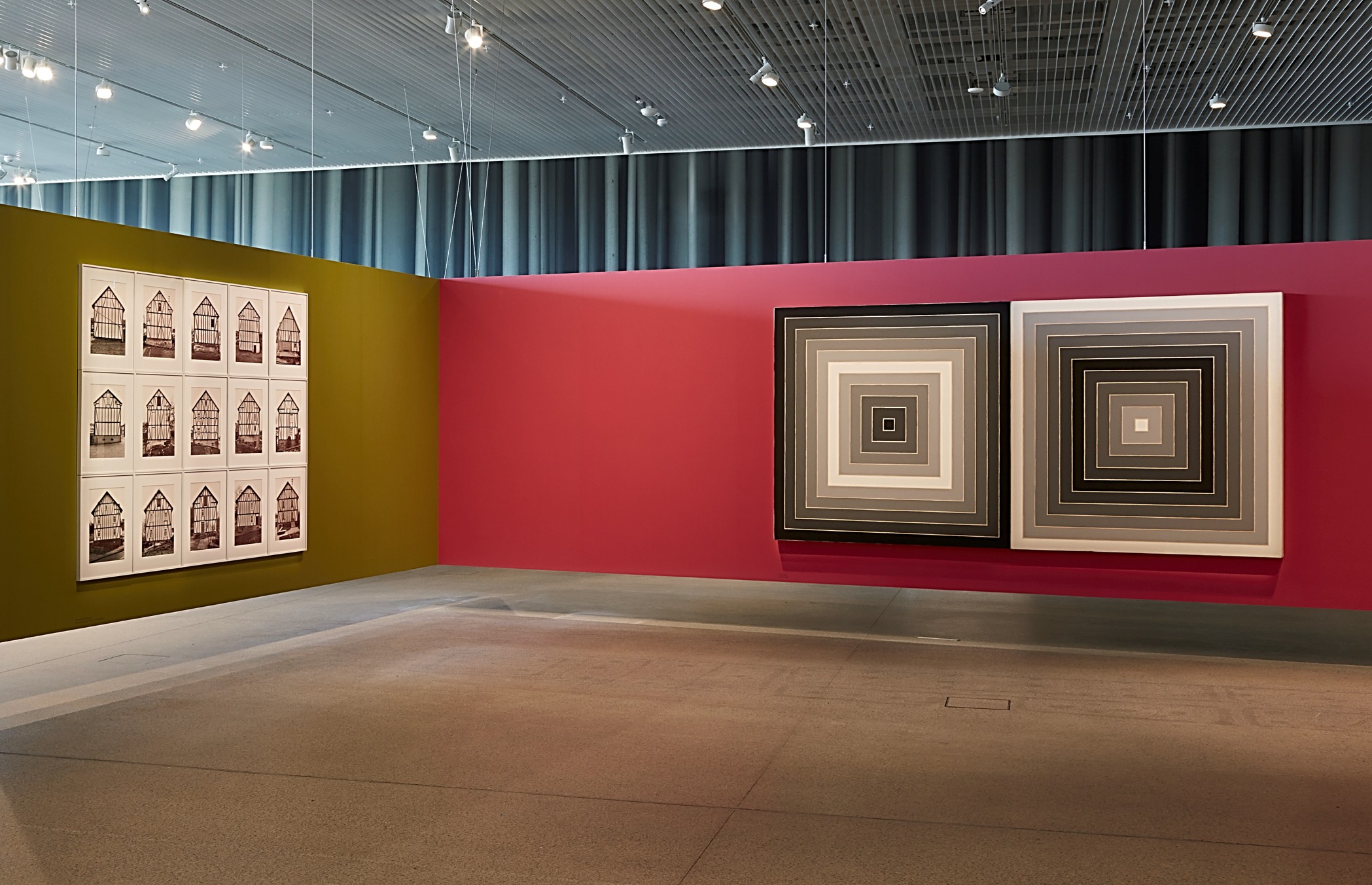
Installation view details: Thomas Demand, Kaldor Public Art Project 38: Thomas Demand: The Object. Art Gallery of New South Wales, Naala Badu, 2025. In view, Bernd and Hilla Becher, Framework houses,1959-1971; Frank Stella, Untitled, 1965. Photo Art Gallery of New South Wales, Jenni Carter.
Elsewhere in the exhibition I was struck by two paintings by the renowned Frank Stella, who died last year. Titled Untitled, 1965, these black and grey and white abstract canvases hang elegantly on a pink screen. Markedly different, is the Swiss-born Ugo Rondinone’s if there were anywhere but desert. wednesday, 2000. Made of fibreglass, paint, and clothing it is an obese clown-like figure sleeping on the ground, his hands held behind his head. On closer inspection we see that the ordinary blanket on which he rests his head is placed on a work by the American minimalist, Carl Andre, Steel-copper plain, 1969. This irreverent gesture might be a wry comment on the gravitas of Andre. He was alleged to have murdered his wife Ana Mendieta in 1985 but acquitted. Nonetheless, the art world still mulls over Andre’s role in her tragic death.
Widely represented in public collections such as the Museum of Modern Art, New York, and Tate Modern, London, the German photographer Thomas Struth is featured in Kaldor Public Art Project 38 by Stanze di Raffaello II, 1990. A large colour photograph from his Museum Photograph series, it shows people in one of Raphael’s rooms in the Vatican, some gesticulating, others bemused and even startled. By contrast, Gilbert & George’s mixed media Rosemance, 2019, gives us the lads in wonderful fluorescent greens and reds standing behind what seems to be a rather grotesque white and grey vegetable-like “thing.”
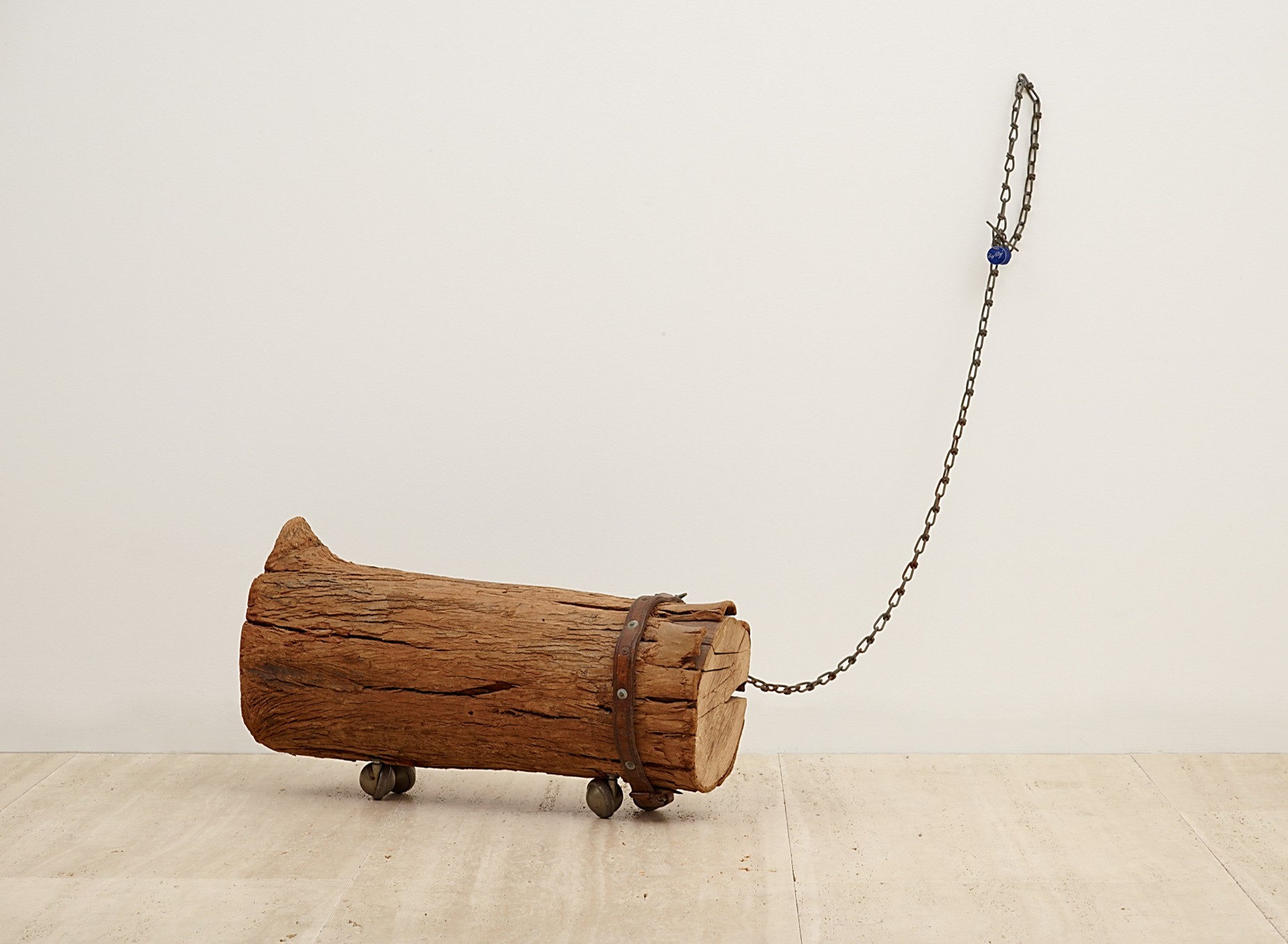
Installation view details, Thomas Demand, Kaldor Public Art Project 38: Thomas Demand: The Object. Art Gallery of New South Wales, Naala Badu, 2025. In view Aleks Danko, Log dog, 1970.
Next to Gilbert & George is Richard Long’s 1992 sculpture Spring Showers Circle, a collection of jagged wooden shapes likely inspired by his walks in England and abroad. The Australian performance artist, Aleks Danko, is not taking his Log dog, 1970, for a walk, but he could; it’s here imagined as a log on wheels with a chain attaching it to a white screen.
Demand has said, “Art is not a clear identifiable message; it is not a given order such as ‘sit’, ‘stand’, or ‘look at me.’ I don’t like to make work that tells you how it should be read. Art should be ambivalent, somehow.” If we were to transfer these sentiments to Kaldor Public Art Project 38: Thomas Demand: The Object Lesson, Demand would seem to be saying that the “lessons” of the exhibition are not about learning per se, but rather creative engagement and, perhaps, even confusion.
EXHIBITION
Kaldor Public Art Project 38
Thomas Demand: The Object Lesson
30 August 2025 – 11 January 2026
Art Gallery of New South Wales, Sydney
Images courtesy of Art Gallery of New South Wales and John Kaldor Family Collection.
Dr Alan Krell is an art historian, writer and lecturer based in Sydney.
This article was first published in Artist Profile Issue 73

Under the auspices of Geelong Gallery’s director, Humphrey Clegg, and co-curated by Marianne Mathieu, former scientific director of the Musée Marmottan Monet, and Claire Durand-Ruel...
Nike Savvas: Purple Haze presents intimate screen prints and immersive large-scale installation and video work by Savvas from 2005–2026, each evocative of different places and...
Although physically he is of modest stature, Zofrea has devoted much of his life to grand projects that have been conceived and executed on a...
Through a multidisciplinary collaboration between Rotterdam-based curators, architect Paul Cournet of CLOUD and artist-designer Sabine Marcelis of Studio Sabine Marcelis, the exhibition explores the interplay...
Artificial intelligence will be used by young artists who started using it as kids on their phones. They will see it as a natural extension...

This year’s Biennale arrives under more complex circumstances than most. It is shaped by the profound loss of its curator, Koyo Kouoh (1967–2025), whose exhibition...
No artist creates in isolation. Every painting carries traces of the conversations, places and histories that shaped it, preserving within its surface a particular moment...
The weekend markets at Fairfield Showground have been one of Western Sydney’s great institutions for more than fifty years. Fresh fruit and vegetables, children’s clothes,...
In recent times, Yorgos Lanthimos has shifted toward photography, noting in a Guardian interview, 2026, that he needs respite, saying, “it might be a couple...